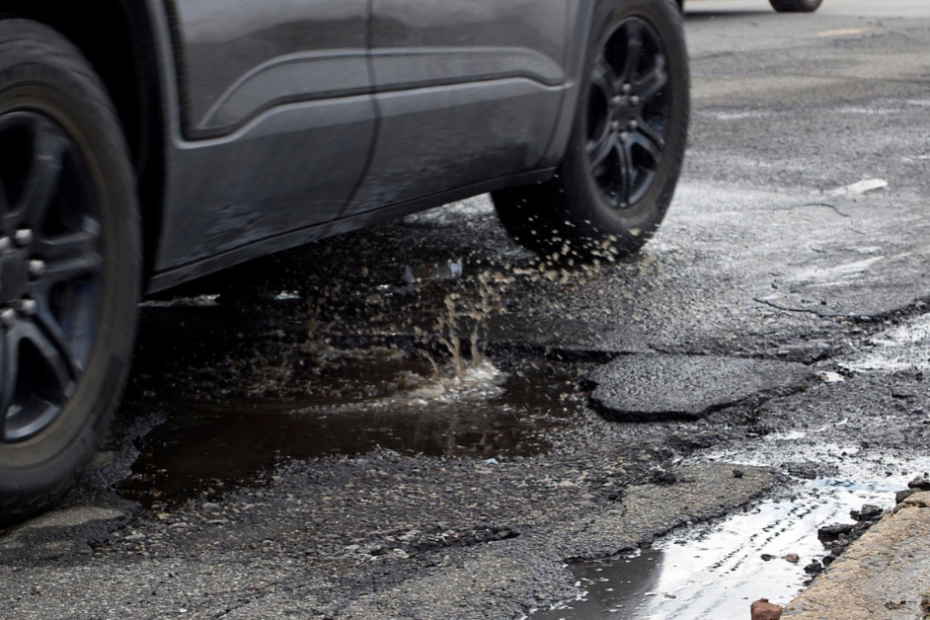
You’re driving along, minding your own business, when suddenly you hit a pothole you didn’t see coming. There’s a loud thud, the steering wheel jerks, and for the next few moments you’re listening for every new rattle or wobble. Once you’ve pulled over and checked the damage, the next question usually hits: is this something my car insurance covers, or is it coming out of my pocket?
The short answer is that it can be covered, but it depends on the coverage you carry and what the repair actually costs. Here’s how pothole damage works with car insurance, and how to decide whether filing a claim is worth it.
Does Car Insurance Cover Pothole Damage?
Often, yes. Pothole damage is generally handled through collision coverage, which helps pay to repair your vehicle after an accident, including when you hit a fixed object like a guardrail, a light post, or a pothole. According to Mercury Insurance, collision applies to your vehicle only and pays regardless of who’s at fault. Since no one is really at fault when a road has a hole in it, that “regardless of fault” part matters.
The catch is that collision coverage is optional in every state. If you only carry the liability coverage your state requires, your policy won’t pay to repair your own car. Liability is designed to cover damage you cause to other people and their property, not the damage to your vehicle.
Which Part of My Policy Pays for Pothole Damage?
Collision coverage is the one to look for. Comprehensive coverage, which is the one people often confuse it with, is built for non-collision events like theft, vandalism, hail, or a fallen tree. Hitting a pothole is treated as an impact, so it lands on the collision side of your policy.
If you’re not sure what you have, your declarations page (the summary page at the front of your policy) lists each coverage you carry. If you’re leasing or financing your car, there’s a good chance your lender required collision coverage, so it’s worth a quick look before you assume you’re not protected.
What Pothole Damage Is Usually Covered?
Collision coverage can help with the kinds of damage a hard pothole hit tends to cause, such as bent or cracked wheels, a tire that was damaged in the impact, suspension components, or damage to the underside of the car. If the repair is tied to that specific hit, it can be part of a collision claim.
What it won’t cover is general wear and tear. Most insurers list normal wear and tear and mechanical problems unrelated to a covered incident among common exclusions, so a tire that was already worn thin or an alignment that had been drifting for months isn’t likely to qualify just because a pothole was the final straw. A sudden, clear-cut impact is what insurers look for.
Does the Deductible Make Filing a Claim Worth It?
This is where most pothole claims land, so it’s important to consider. With collision coverage, you pay your deductible first, and your insurer pays the rest of a covered repair. Deductibles can range from $0 to $2,000, with $250, $500, and $1,000 being the most common. You can read more about how car insurance deductibles work if you want the full breakdown.
Here’s an example to consider. If a bent rim costs $450 to fix and your deductible is $500, your insurer wouldn’t pay anything, because the repair is less than what you’d owe up front. If the same pothole damaged a wheel, a tire, and your suspension for $1,500, you’d pay your $500 deductible and your insurer would cover the remaining $1,000, up to your policy’s limits.
It’s also worth thinking about the bigger picture before you file. Depending on your insurer and your state, a claim can affect your rates down the road, so a repair that’s only slightly over your deductible may not be worth the trade-off. When you’re close to the line, a quick call to your agent can help you weigh it without committing to anything.
What Should I Do After Hitting a Pothole?
If you think your car took a real hit, a few steps can protect both your safety and a potential claim:
- Pull over somewhere safe and check the car: Look for a flat or bulging tire, a bent wheel, fluid leaking underneath, or new warning lights on the dashboard. If anything seems off, don’t keep driving on it.
- Take photos of the pothole and the damage: Capture the pothole itself, including its location and size if you can, along with any visible damage to your wheels, tires, or undercarriage.
- Note where and when it happened: A street name, a rough time, and the date are all useful details if you decide to file.
- Get an estimate before you decide: A repair shop can tell you what the damage will cost, which makes it much easier to compare against your deductible.
- Contact your insurer or agent if the repair is significant: They can explain what your policy covers and walk you through the claims process.
You may also be able to file a claim with the city, county, or state agency responsible for the road, but those rules and deadlines vary widely by location, so it’s worth looking into locally if the damage is substantial.
Why Are There More Potholes Around Fall and Winter?
Potholes form when water seeps into small cracks in pavement and then freezes and thaws repeatedly, which weakens the road underneath. Heavy traffic wears those weak spots down until they break apart. Fall rain and cooler nights start that cycle in many areas, and the problem tends to get worse as winter goes on, so it’s a good season to stay a little more alert, especially after a storm when water can hide how deep a hole really is.
A few habits can help: leave extra space behind the car in front of you so you can see the road ahead, slow down on roads you know are in rough shape, and try not to swerve suddenly to avoid a hole, since that can create a bigger hazard than the pothole itself.
Talk to an AIS Auto Insurance Specialist
Not sure whether your policy includes collision coverage, or whether your deductible still makes sense for the way you drive? AIS can help. Our specialists can walk you through what your auto policy covers, explain how your deductible would factor into a claim, and see if there’s room to adjust your coverage to fit your budget. Call (888) 772-4247 or start a quote online to review your options.
The information in this article is obtained from various sources and offered for educational purposes only. It should not replace the advice of a qualified professional. The definitions, terms, and coverage in a given policy may be different than those suggested here. No warranty or appropriateness for a specific purpose is expressed or implied.